

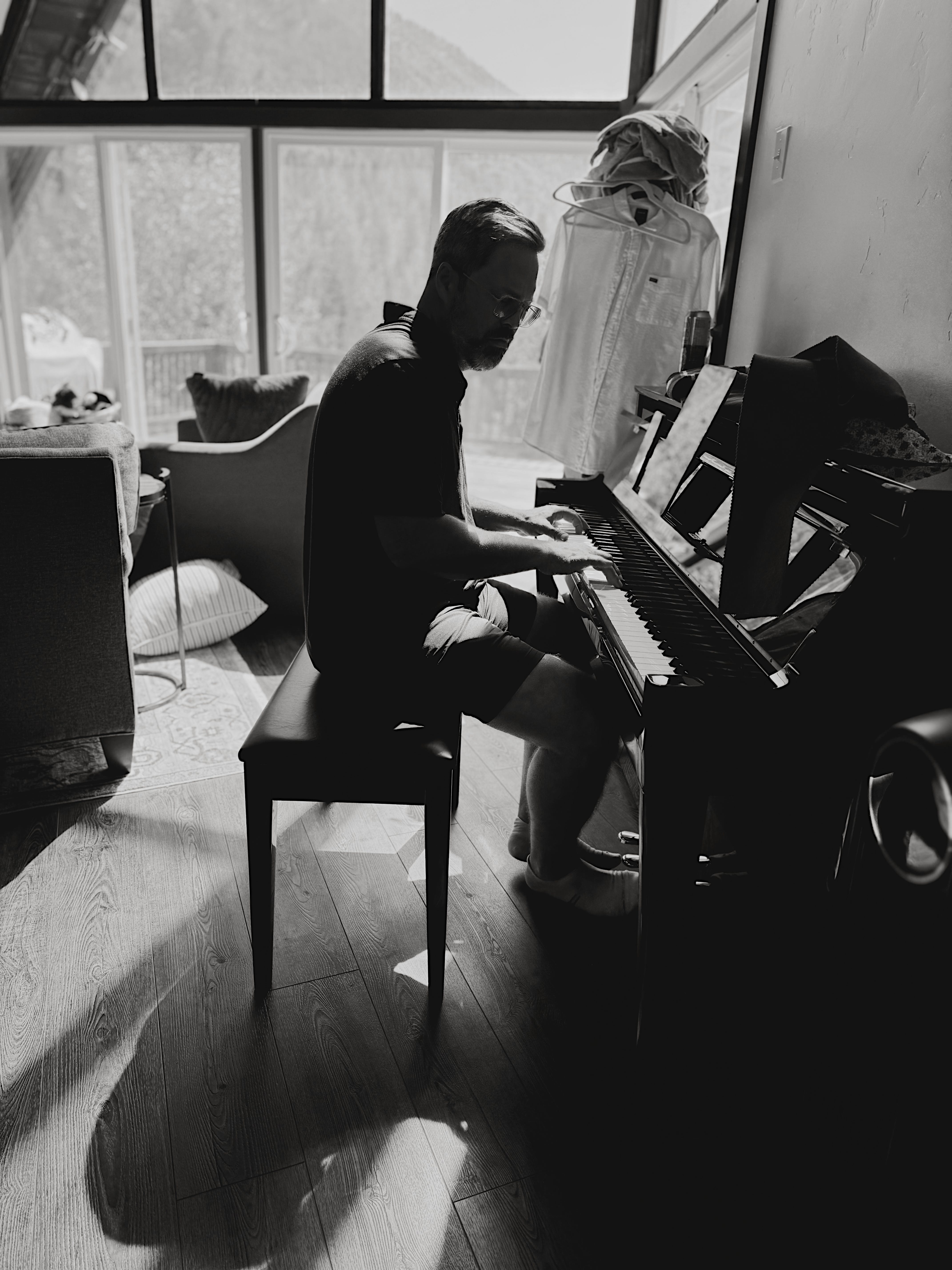
I didn’t know I was making an album.
I didn’t know I was becoming a musician. I didn’t know if I would ever find myself again.
I was just trying to feel alive for a few minutes at a time.
My marriage was falling apart, I had left my religion, and I was watching my software startup being dismantled in a forced liquidation. So many old identities had collapsed that I could no longer tell which parts of my life were still authentic. I didn’t know who I was anymore. So I drove into the mountains and started playing the piano until something true started to show up.
Day after day I would sit down at an upright piano in my cabin, turn on my phone, and play whatever came. Some days it was fear. Some days it was grief. Some days it was despair. Some days it was just the sound of the canyon working its way through me slowly enough that I could breathe again.
The ten songs on this album came from that season. Not because I set out to write them. Because I allowed them to come through and they stayed.
After 22 years of marriage, we told our kids we were getting divorced. It was not the only loss. It was just the one that made the others impossible to outrun.
A few years earlier I lost my religion.
For most of my life, my religion was more than a set of beliefs. It was a complete framework for reality, held inside a tight-knit community that had shaped me since birth. That kind of psychological loss is hard to explain unless you have lived it. It is not only a change in belief. It is a change in belonging.
It changes your calendar, your friendships, your language, your relationships, and your sense of what makes a good life. It can leave you questioning your own goodness and value, apart from the community that once helped define them.
Then came the financial loss.
I had spent nearly ten years creating and building software from scratch. I had imagined it, created it, raised money for it, fought for it, and carried it through all the hope and strain that comes with venture-backed entrepreneurship. Eventually, that business went through forced liquidation. Bankruptcy. A word I never imagined would be part of my story.
I had been better off financially ten years earlier than I was at the end of that process.
Then my divorce was final.
Four kids. Twenty-two years. A whole adult life braided together with another person. A home, a family system, a set of assumptions about the future. A lot of effort. A lot of hope. A lot of longing for what I thought the relationship might become.
And then it did not become that.
By last summer, I felt like almost every identity I had built was cracking at once. The faithful one. The married one. The provider. The founder. The practical finance guy. The person who had made responsible choices and expected those choices to eventually create safety.
Instead, I felt naked and alone. And I was starting over.
That is a hard thing to admit when you have spent your career helping other people feel grounded around money.
But that was the truth.
Most days, I was either anxious about the next step in the divorce process or heavy with a kind of depression I could not think my way out of. I knew my kids needed me. I knew they needed love, steadiness, structure, and care. But beneath that responsibility, I was struggling to feel like I mattered to anyone.
I felt hurt. Cold. Numb.
I did not know where to go with all of it.
One day in therapy, my therapist suggested that I try to find something that helped me feel emotions again.
She didn’t know much about my history with music. I had played piano since I was young. I studied music in college. But somewhere along the way, music had become something I used to do. Something from another life. A younger life. A less practical life.
She said something simple.
“You play piano, right? Maybe you should try playing again.”
I didn’t really want to play other people’s music. I wasn’t feeling covers. I didn’t even know what I would want to play.
So I just started playing. Improvising.
Not practicing. Not performing. Not trying to make something impressive.
Just playing what came to me, and through me.
At first, it was rocky. I would sit down and search for sounds that felt good in my hands. Sometimes I would land on a small phrase that broke up the pain for a few seconds. Sometimes it just gave shape to the silence in the room.
So I started recording myself.
I would turn on my phone and record for five minutes. Sometimes fifteen minutes. I did this almost every day for a while. Some days I would go on Facebook Live, set up a mic, and share a little of what I was playing with friends. I did not have a plan. I was not launching anything. I just thought, if this is helping me feel something, maybe it might help someone else feel something too.
The response surprised me.
A few people told me the music moved them. That it touched something. That it helped them think, or calm down, or feel less alone in their day.
There were no lyrics. No band. No dramatic performance.
Just me, playing piano.
And still, something was happening.
That was hard for me to accept at first. How could simple, imperfect music that was coming from the ruins of who I used to be help me? Help anyone? I did not feel worthy to be an artist. I knew how to be useful. I knew how to be practical. I knew how to be the finance person, the founder, the advisor, the responsible one. But the idea that I might share music as something meaningful felt foreign.
I had abandoned that part of myself a long time ago.
I kept driving up the canyon.
I would leave my house and drive up to my cabin. The canyon became a kind of shelter for me. I started noticing how much I depended on that drive. The mountains, the river, the trees, the stone, the light. The silence up there was not empty. It held me.
When things got hard, I would get in my car and drive.
I would sit down at the upright piano in the cabin and play whatever I felt.
Some days, what came out was fear.
Some days, it was grief.
Some days it was anger.
Some days, it was the beauty of nature doing something I could not do for myself: embracing me without judgment.
Every time I played, I felt a little more grounded.
Not fixed.
Grounded.
That distinction matters to me.
The music did not solve my life. It did not make divorce easier. It did not restore the money. It did not hand me a new identity fully formed.
It just gave me enough calm in each moment and no more.
Enough connection to not disappear.
Enough beauty to keep going.
That summer, I took a road trip with my brother, my three sisters, and all their kids. We went through Idaho, up to Redfish Lake and Stanley, then into Montana and Glacier National Park. It was one of those rare trips where the beauty feels almost too large to process.
I brought the recordings with me.
As I drove through those long stretches of mountain country, I would play the piano recordings from my phone. They calmed me. They helped me breathe. They helped me feel connected to something larger than the divorce, larger than the business failure, larger than the story I had been telling myself about what my life was supposed to become.
When I got home, I knew I could not stop.
Continue to read Part 2.
Thank you for sharing your story. I felt so much of this and resonate with a lot of your journey. The divorce process has broken me in ways I wasn’t ever going to be prepared for. But, like you, music has helped me find grounding again. I’m looking forward to listening to your music soon!
Reese, what a beautiful reflection on such a difficult time. My faith unraveled in that religion as well a couple of years ago and that alone was so hard. I can't imagine how hard it was for your marriage and business to come apart at the same time. Thanks for your being so honest and vulnerable!